How Coca-Cola Established A Repeatable Model For Old-City Expansion
Background
Coca-Cola is one of the world’s largest consumer brands, operating at massive scale across complex local markets. In India, many major cities include “old city” districts where retail density is high but logistics are difficult. These areas are made up of narrow lanes, heavy foot traffic, and tightly packed stores. Demand can be strong, but traditional distribution systems often struggle to serve them consistently.
Challenge
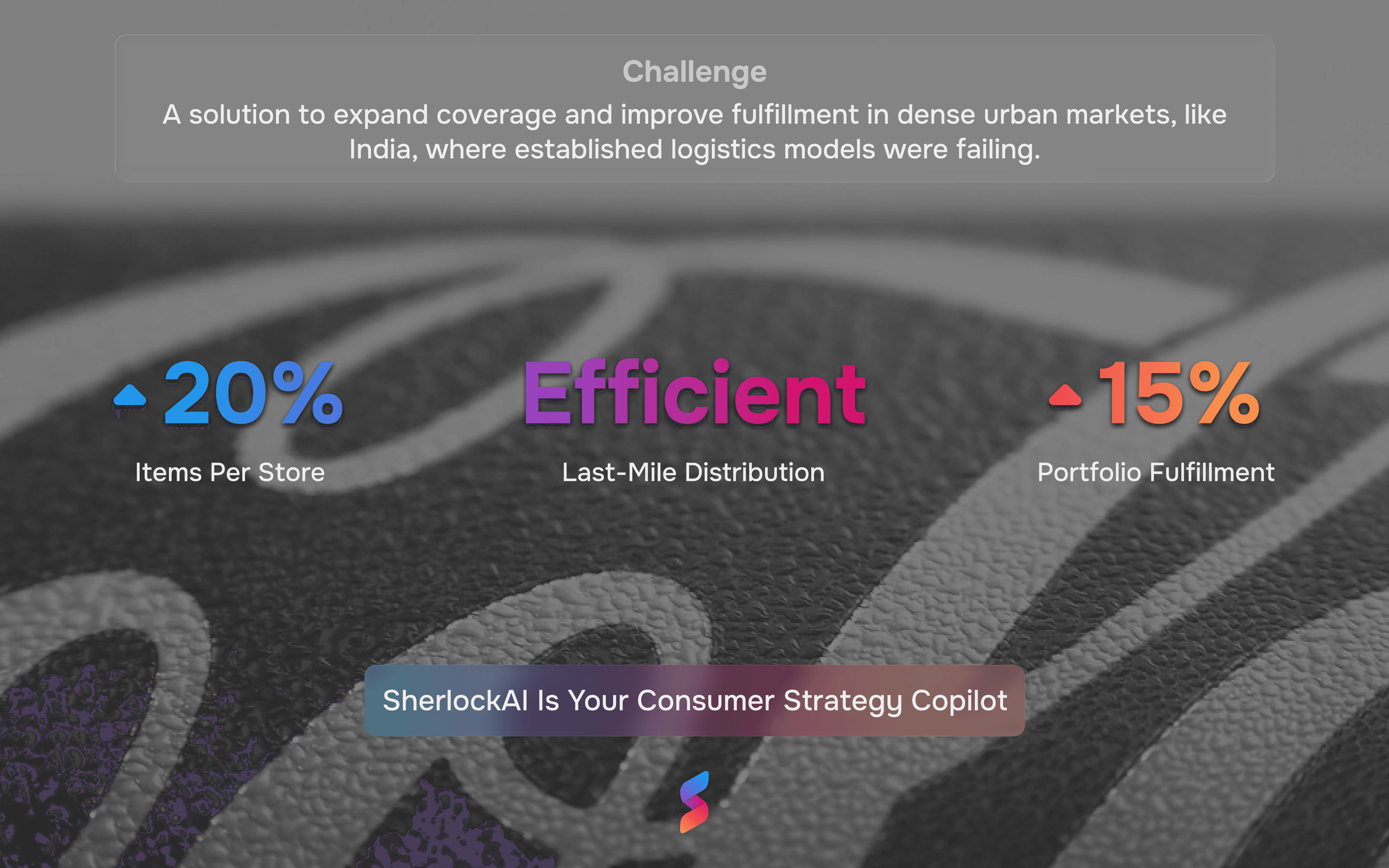
For Coca-Cola, these markets represented a meaningful opportunity, but the existing model wasn’t built for them. In many areas, trucks simply couldn’t reach the inner lanes reliably. Supply planning often relied on rough assumptions instead of clear store-level demand. Coca-Cola tested dark-store approaches, but the economics didn’t hold considering rent and cooling costs. The company needed a way to expand coverage and improve fulfillment without adding high fixed costs.
Approach
SherlockAI worked with Coca-Cola to map and prioritize old-city markets at a more detailed level. Using SherlockAI’s Real-World Consumer Behavior Graph, the team mapped stores and uncovered pockets of demand that were not visible through traditional planning methods.
SherlockAI then ranked stores based on real-world signals including footfall, spend, and observed consumer behavior, helping Coca-Cola focus distribution effort on the outlets most likely to drive volume. The platform also supported servicing decisions by showing where direct servicing made sense versus where distributor-led servicing was the better option.
Solution
Coca-Cola used SherlockAI’s outputs to redesign how these old-city markets were served. Instead of forcing a truck-based model into areas where it routinely broke down, the team shifted last-mile delivery to electric bikes and scooters that could reach inner lanes consistently. In parallel, Coca-Cola launched a B2B supply app to enable real-time ordering and inventory visibility, and used SherlockAI to validate and optimize the rollout based on what was happening on the ground.
Within weeks, Coca-Cola increased items per store by 20% and improved portfolio fulfillment by 15% across some of the hardest to serve zones. Just as importantly, the project created a repeatable model for old-city expansion: identify true demand at the store and cluster level, prioritize the right outlets, and execute with a last-mile approach built for the physical reality of the market.
Compliance Note
SherlockAI utilizes strictly anonymized and aggregated data. No Personally Identifiable Information (PII) is used, stored, or shared. All methodologies are fully compliant with global privacy standards, including GDPR and CCPA.
The future of your industry starts here